Daily Reconciliation Dashboard 💰
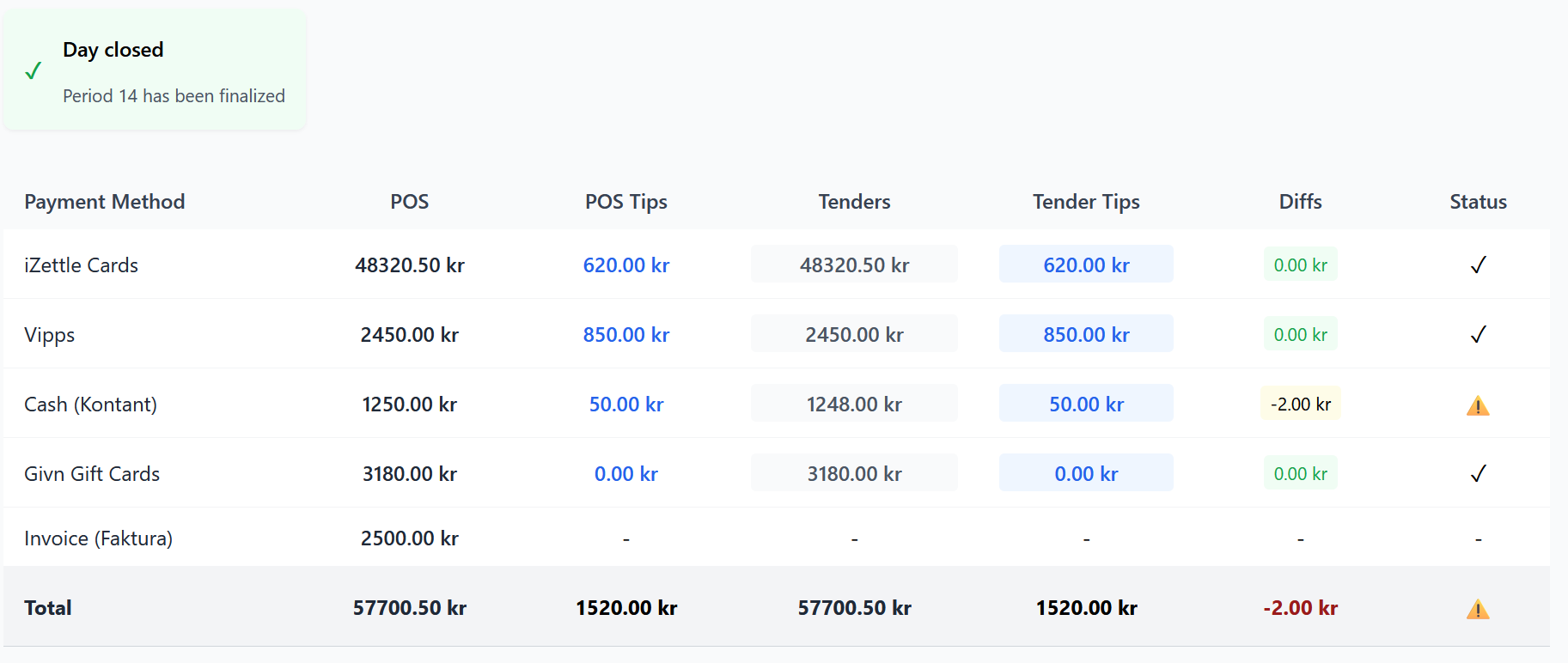
An internal financial dashboard that transforms complex POS data into clear, actionable insights for restaurant managers and accountants. Compares point-of-sale transactions with actual payment tenders across multiple payment methods, highlighting discrepancies in real-time. This ongoing project demonstrates expertise in data visualization, business logic implementation, and building practical tools that solve real operational challenges.
🛠️ Technical Implementation
Frontend Framework
- React with functional components
- TypeScript for type safety
- React Hooks (useState, useEffect, useCallback)
- Component-based architecture
- Modern React patterns
Business Logic
- Complex payment method routing
- Multi-source data comparison
- Real-time difference calculations
- Conditional rendering logic
- Status-based visual feedback
Data & Integration
- RESTful API integration
- Backend collaboration
- POS system data processing
- Payment tender verification
- Multi-location support
📋 Key Features & Highlights
Multi-Payment Tracking
Handles iZettle, Vipps, Cash, Gift Cards, and multiple payment methods with separate tip tracking.
Visual Status Indicators
Color-coded differences (green for matched, yellow for minor, red for significant) with clear icons.
Multi-Location Support
Tracks three locations (DLC, Cafe, Odins) with location-specific color schemes.
Date Navigation
Easy navigation between days with period status tracking and validation checks.
Smart Alerts
Automatic warnings for open tables, unclosed periods, and open food items.
Cash Counter Integration
Built-in cash counting modal with API submission to payment system.
🚀 Development & Problem Solving
🎯 The Business Challenge
Before this dashboard, managers had to manually scroll through raw POS data with difficult-to-read numbers to reconcile daily transactions. The process was time-consuming, error-prone, and required mental math to spot discrepancies across multiple payment methods and tip categories.
🎯 Solution: Transform Raw Data into Clear Tables
Before: Raw numbers requiring scrolling and manual calculations
After: Clean, organized table showing POS vs Tenders with automatic difference calculations and visual status indicators
Impact: Saves several minutes per closing and reduces accounting errors
⚙️ Complex Payment Logic
The most technically challenging aspect was implementing the payment method routing logic. Different payment methods appear in different columns (POS-only, Tenders-only, or both), and tips are tracked separately for specific methods. This required careful conditional rendering and business rule implementation.
🎯 Implementation Highlights
shouldShowInPOS(): Determines which methods display in POS column (excludes delivery types)
shouldShowInTenders(): Filters POS-only methods like faktura, offline, brekk
Tip Tracking: Separate logic for POS tips vs Tender tips per payment method
🔄 Ongoing Development & Iteration
This project is actively being developed and improved based on real user feedback from managers and accountants. Working in test mode allows safe development while the backend team builds out remaining features like cash tender submission.
🎯 Current Status
Completed: Core reconciliation UI, payment routing, visual indicators, date navigation
In Progress: Cash counter backend integration, testing with staff
Next: Production rollout to all locations
💡 Technical Challenges & Solutions
🧮 Payment Method Routing Logic
Challenge: Different payment methods need to appear in different table columns with specific tip handling rules.
Solution: Created helper functions (shouldShowInPOS, shouldShowInTenders, shouldShowPOSTips) that encapsulate business rules and keep components clean.
📊 Data Visualization for Complex Financial Data
Challenge: Making 6+ payment methods with separate amounts, tips, and differences immediately understandable.
Solution: Color-coded status system (green/yellow/red), clear icons (✓/⚠️/❌), and organized table layout with distinct POS vs Tenders columns.
⚡ State Management for Multi-Source Data
Challenge: Managing period status, open tables, open items, payment data, and location state efficiently.
Solution: React hooks (useState, useEffect, useCallback) with proper dependency arrays and memoization for optimal performance.
🤝 Backend Collaboration
Challenge: Coordinating frontend development with backend API development by Jerome.
Solution: Test mode flag for safe frontend development, clear API contract definition, and iterative integration testing.
🏆 Code Quality & Best Practices
🎯 Business Logic Clarity
Extracted complex payment routing into named helper functions for readability and maintainability.
🔒 Type Safety
TypeScript ensures data structure integrity and catches errors during development.
♻️ DRY Principle
Reusable status color/icon functions prevent code duplication across components.
🐛 Safe Development
Test mode flag allows frontend iteration without affecting production data.
🌟 Planned Enhancements
💰 Cash Tender Backend
Complete cash counter API integration for direct submission to payment system.
📱 Mobile Optimization
Enhanced mobile layout for managers doing closing on tablets or phones.
📊 Historical Trends
Add charts showing reconciliation patterns over time to identify recurring issues.
🔔 Alert System
Automated notifications for significant discrepancies or unusual patterns.
📝 Notes Feature
Allow managers to add notes explaining specific discrepancies for accounting records.
📤 Export Functionality
Export reconciliation data to CSV for accounting software integration.